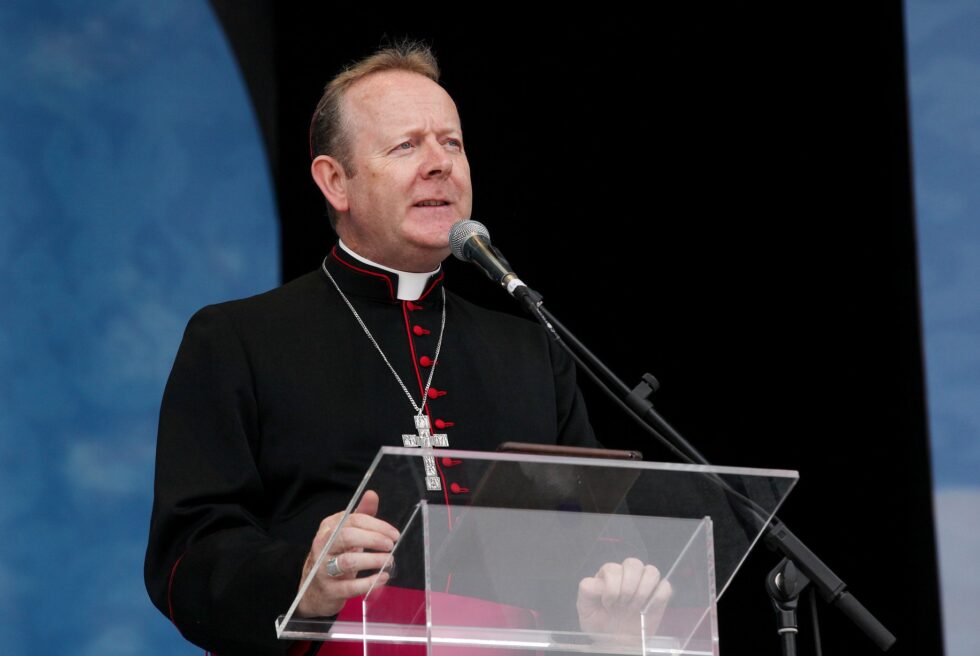
• Homily of Archbishop Eamon Martin for the 2026 All Ireland Rosary Rally on ‘Mary and the Age of Artificial Intelligence’
“To thee do we cry, poor banished children of Eve; to thee do we send up, our sighs, mourning and weeping in this valley of tears”.Friends, in recent months I’ve been reflecting more and more on that heartfelt prayer to Mary from the Salve Regina – the Hail Holy Queen!
In many ways our world these days is like a “valley of tears”. We seem surrounded by bad news: of war and violence, greed and hunger, extreme weather events, viruses, human trafficking, and many attacks on the dignity of human life.
I find that more and more people are asking me for a blessing or for a prayer because they are afraid: for the world, for their loved ones, and for themselves. You probably found that when you said you were going to Knock today – friends and family members asking you to pray or light a candle for them.
But we need not be afraid. We have come to the right place. Knock is a place of healing, where we, “the poor banished children of Eve” can turn in confidence to Jesus, through Mary.
I love that Mary is sometimes known as: ‘the new Eve’! What a beautiful title that is, and so full of meaning! From the earliest days of Christianity, theologians like Saint Irenaeus, and Saint Justin Martyr, liked to describe Mary as ‘the new Eve’, as did the saintly Cardinal John Henry Newman in the 19th century. They saw in Mary’s wholehearted “Yes” to God at the Annunciation, when she surrendered freely and fully to God’s will, a complete reversal of Adam and Eve’s disobedience of God in the garden, whereby sin and death entered into the world.
Hence Mary is the “New Eve”. She restores confidence that humanity can return to the way God wanted it to be when God first created us!
The Catechism describes it like this:
“From among the descendants of Eve, God chose the Virgin Mary to be the mother of his Son … she “co-operated in human salvation through free faith and obedience” (LG 56).
She uttered her yes “in the name of all human nature”.
By her obedience she became the new Eve, Mother of the Living.” (CCC 508-511)
Brothers and sisters, let us not be afraid then to “send up our sighs” to Mary today at this Rosary Rally: deep spiritual sighs of surrender, handing everything that troubles us over to Jesus through Mary. (A few weeks ago at the grotto of Our Lady in Lourdes, I found myself breathing in deeply the breath of the Holy Spirit and then, in a great spiritual sigh, breathing out all my worries, my questions, my intentions and petitions to Mary, our Blessed Mother. It was as if I could hear those words of Jesus from the cross:
“Behold your Mother”; His invitation to “send up our sighs” to her. At that moment Jesus was entrusting us, the ‘poor banished and broken children of Eve’ to Mary, the New Eve, the model for humanity, and mother all the living.
Friends, two weeks ago, Pope Leo XIV chose to issue his first encyclical to the world on the feast of Mary, Mother of the Church. The encyclical is entitled Magnifica Humanitas (on the grandeur of humanity), and it is a reflection on protecting the Human Person in this new age of Artificial Intelligence.
I think that was no accident that Pope Leo chose Mary’s feast to launch the encyclical. At this historic phase of human history, Pope Leo was once more placing the care of all humanity in the loving hands and heart of Mary, mother of all the living, the New Eve.
Artificial Intelligence is already shaping human life in homes, workplaces and communities, in hospitals, public services and economies. AI can do remarkable and helpful things. It can sort through vast amounts of information, recognise patterns, and accelerate developments in medicine, education, science and environmental protection. It can even mimic human behaviour and voices, but: it cannot love, suffer, forgive, pray or hope as humans can, nor can it be truly “wise”. AI does not have a conscience.
As Pope Leo puts it: “artificial intelligences do not experience life, do not possess a body, do not experience joy and pain, and do not know from within what love, work and responsibility mean”.
The Holy Father is rightly concerned that artificial intelligence may lead to our building a world of pride, profit, domination and confusion; a world where God our creator is forgotten; a world instead where human beings think ‘we can be God’ – the classic temptation of Adam and Eve by the serpent in the garden of Eden.
Instead, Pope Leo proposes a vision of building the holy ‘City of God’, upon foundations of peace and reconciliation, love and fraternity; a world deeply respectful of human dignity for all. This is a world where people reach up in thanksgiving to the transcendent God their Creator who saved humanity from itself by sending His only Son, Jesus, the New Adam, born of the Virgin Mary, the New Eve.
Pope Leo asks us not to forget that every human being has a unique face and a voice. Before a person is a profile, a statistic, a screen-name, a consumer, a complainant, or a “case,” they are someone created in the image and likeness of God. And he reminds us that when God wanted to save humanity from pride, sin and death, God chose to do so by coming among us with a human voice, a human face and a human heart.
Christians, and all people of goodwill, might therefore ask of Artificial Intelligence: Is it true? Is it just? Does it honour the human person made in God’s image? Does it protect the vulnerable and serve the Common Good, or does it simply accumulate wealth and power in the hands of a few? What is its impact on human life and dignity, solidarity, justice, care for God’s creation? Does it serve human persons or instead tend to dehumanise or even aim to replace them?
That is why I encourage you at this Rosary Rally to pray often, in union with Mary, for the protection of humanity in this rapidly advancing technological age.
Mary, the New Eve, the Mother of all the Living, acts like a ‘compass’ to guide us through the uncharted waters that lie ahead.
Pope Leo says Mary directs our gaze to “the points at which humanity is broken and the world becomes distorted” (MH 244). She teaches us “to look at the world… through the eyes of those who suffer rather than the mighty; to view history through the eyes of the little ones, rather than through the perspective of the powerful; to interpret the events of history from the viewpoint of the widow, the orphan, the stranger, the wounded child, the exile and the fugitive.”
And when we send up our sighs to Mary, she ponders them in her Immaculate Heart – she holds close our fears and anxieties, and all the complicated and confusing questions that face humanity at this time. Mary knows our human weaknesses; she realises the temptations that face us.
And her Immaculate Heart implores us to seek the ways of peace in the world; to pray the Rosary every day; to be nourished by the Eucharist and Confession. Mary urges us to make reparation for the sins that threaten to destroy the ‘grandeur of humanity’. She points us to a “civilisation of love”, beauty, truth charity and forgiveness, and with motherly care she endeavours to turn us away from the ugliness of selfishness, anger, violence war, greed and exploitation of the weak.
She is the Queen of Peace and she promised peace to the world at Fatima, if only we can be faithful to the rosary and to her Immaculate Heart.
Mary’s Immaculate Heart – together with the Sacred Heart of Jesus – reminds us to love, even when it hurts, and invites us to draw close, heart to heart with her and with the Lord, so that we will never forget that ‘we are loved’ and ‘we are called to love others’, with tenderness and compassion, especially the vulnerable the poor the sick and suffering.
And so Pope Leo concludes his first encyclical, Magnifica Humanitas, encouraging us to be like Mary, “weavers of hope” in the world, and asking that she, the Mother of Christ, the Woman of the Magnificat, may guide our steps through this time of change so that we may “bear witness to the grandeur of humanity, in which God has made his dwelling.” Amen.
ENDS
• Archbishop Eamon Martin is Archbishop of Armagh and Primate of All Ireland. This homily will be delivered today during 3.00 Mass at the Basilica of Our Lady in the International Eucharistic and Marian Shrine in Knock, Co Mayo, Archdiocese of Tuam, for the 41st All Ireland Rosary Rally. For the full schedule, please see www.allirelandrosaryrally.com.