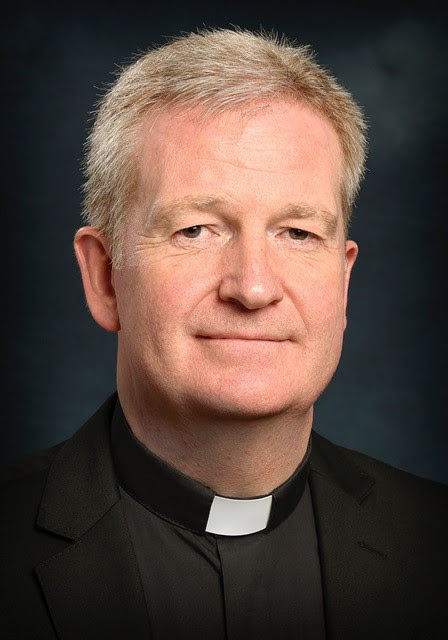
Caption Bishop Paul Dempsey, Auxiliary Bishop of the Archdiocese of Dublin (Catholic Communications Office archive)
- Homily of Bishop Paul Dempsey during Mass for the annual State Commemoration Service for the 1916 Leaders in the Church of the Sacred Heart, the Church of the Defence Forces, Arbour Hill, Dublin
Last January I was part of a delegation that visited the West Bank. While we were there, we had the opportunity to meet many groups on all sides. It was a powerful experience to meet people and to listen to their personal stories of living in a very challenging time.
Out of all the groups we met, there was one that probably touched our hearts the most. We met a Palestinian Muslim father, a Jewish mother, and a Palestinian Christian father, three members of a group called the ‘Parents’ Circle.’ In total the membership comprises of about eight hundred and fifty.
However, this is a group that no one wants to be a member of because, despite of their very different religious, cultural and social backgrounds, they all hold something in common, they lost a child in the conflict. The two Palestinian dads lost a daughter, aged ten and twelve. The Jewish mam, lost her son, taken when he was twenty-two. One could hear a pin drop as they told their personal stories of grief.
The conflict in the Holy Land has received much publicity, we see the headlines, the stark numbers of so many lives lost, families destroyed by pain and grief. But behind each statistic is a personal story, the story of the heartache of a loved one lost, most especially felt in the loss of a child. However, what was most powerful about our encounter with these three parents was their witness. Despite the deep pain inflicted upon them and their families, they didn’t carry anger or hatred, or the desire for revenge, on the contrary they believed in forgiveness. They told us that “forgiveness releases you from the prison of your own inhumanity”. The members of the ‘Parents’ Circle’ wanted to chart another way forward where Palestinians, Jews, Christians and Muslims could, despite their differences, of which there are many, can share life together in peace. They noted that human suffering has no flag, and tears do not have an exclusive nationality.
I reflected upon this experience in light of what we gather for here this morning, our remembrance, in prayer, of the 1916 leaders, those who gave their lives so that we could live in a free democracy today. As we look back and remember, perhaps there is the danger that we see the statistics and hear the famous heroic names that are etched on the heart of our Nation, but we might forget that behind each one is a personal story, a story of family, of love, of faith, of struggle, of commitment and of grief.
I recently came across a short video clip of an interview with Tom Clarke’s wife, Kathleen. It is a very poignant interview. She shared how she was taken under armed guard to Kilmainham, but no one told her that her husband Tom was going to be executed. She was brought into his cell, where the only light was from a candle in a jam jar. A soldier stood in the cell with them giving them no privacy. They had about an hour together, and interestingly she said they didn’t talk about anything personal; they talked about the future and the future of the country. Tom shared with her that he believed he and the others who were about to give their lives had “saved the soul of Ireland”.
That “Soul of Ireland” was outlined in the Proclamation where they envisaged a Republic that “guarantees religious and civil liberty, equal rights and equal opportunities to all its citizens”. And it goes on to see it “cherishing all the children of the nation equally“. One cannot but see how this vision was inspired by their personal faith and sense of justice. One can sense the importance of their faith in The Proclamation itself, the opening words addressing Irish men and Irish women and invoking God. It concludes by placing the Irish Republic “under the protection of the Most High God”.
The Ireland of today, one hundred and ten years on, is very different. We have advanced in so many ways. In this context some in our society might look back to over a hundred years ago and see the 1916 Leaders’ sense and understanding of faith as something out of touch, old fashioned and perhaps naïve. However, when one looks somewhat deeper and reflects upon their vision of a free Ireland, where the rights and equal opportunities for all would be respected, I see something far deeper and profound. Twenty-five years before the Rising, Pope Leo XIII wrote his groundbreaking Encyclical Rerum Novarum (Of New Things). In this he outlined revolutionary change in the area of workers’ rights and the dignity of human labour. It formed the foundation for Catholic Social Teaching based on the sacredness and dignity of every human person, and especially the option for the poor and vulnerable so close to the heart of Jesus Christ outlined in the Gospels.
The 1916 Leaders believed in the dignity of every human life, they wanted equal opportunities for all, and no one was to be left behind. This is far from naïve or out of touch or old fashioned. On the contrary, their vision is as real and alive and as challenging as ever. They challenge us to look to those in our society who are on the margins, who have no voice, those who are not listened to. They challenge us to reflect upon our own lives and how we promote a sense of justice and fairness so that all can be “cherished equally”.
There are some voices today who promote a sense of exclusivity, but this is not in the spirit of the 1916 leaders’ vision for the Republic. A few moments ago, I mentioned my encounter with the ‘Parents’ Circle,’ in the West Bank, they are mams and dads, from very different backgrounds but united in grief. They shared something very important with us, they said when you don’t know people, you can fear them. To overcome fear, you must encounter the other and listen deeply in order to understand. On this journey of encounter and listening they believed people of different faiths, cultures and world views can live together in peace. Through the witness of these parents, I saw what is possible. I also see this sense of possibility in the vision outlined by the 1916 Leaders. Their sense of community, belonging, togetherness and their passion for what is possible inspired them to lay down their lives for others.
In the words of the Gospel today, the “seed must die to yield a rich harvest”. The 1916 Leaders gave their lives and, through the shedding of their blood, a rich harvest of a free Republic eventually came about. But as we know, we don’t live in a perfect society; there are many challenges. As part of a global village, we see how the wars and destruction in so many parts of the world at this time can leave us feeling somewhat despondent. In this context the words of the late Seamus Heaney are apt, “Even if the hopes you started out with are dashed, hope has to be maintained.”
The 1916 Leaders had many hopes, they may have been ‘dashed’ for a while, but they never gave up on that hope. Tom Clarke and his wife, in his final hours in that cell in Kilmainham, talked about the future. It brings home how the leaders maintained their hope by looking to a brighter tomorrow despite the setbacks. What a powerful witness that is to us right now in this moment! Despite the challenges of today in our world and society, the witness and example of the 1916 Leaders remind us of the resolve of the human spirit and encourages us to transcend the prophets of doom and look to what is possible.
As we gather this morning, despite our own differences, we unite with one heart to remember, cherish and give thanks for those who sacrificed so much for us. We do so here in this sacred place, in the presence of their family members and loved ones. We remember you all in a special way today. The 1916 Leaders were not just revolutionaries; they were family members with their own unique story. They were people who loved, struggled, worried, had fears and anxieties like us all. But they were driven by a bigger story of hope, a story inspired by their personal faith and a sense of justice and peace.
Today we give thanks to God for their lives, and we commend them to the love and mercy of God, the God whom, in their human frailty, they followed and served. May we continue to strive to create a society worthy of their memory, a society “cherishing all the children of the nation equally.” May we look to the future with hope, inspired by those gone before us and knowing that, despite differences in culture, beliefs and world views among us, when we recognise the sacredness and dignity of each person then we can live in peace and harmony with one another.
In ár gcroíthe go deo. Ar Dheis De go raibh a n-anamacha. Amen.
ENDS
- Bishop Paul Dempsey is Auxiliary Bishop of the Archdiocese of Dublin.
- This homily was delivered today during Mass at the Annual 1916 Commemoration Requiem Mass that takes place at the Church of the Sacred Heart – the Church of the Defence Forces – in Arbour Hill, Dublin, beside the burial site of the executed leaders of the 1916 Rising. This Mass is celebrated on the first Wednesday on/after 3rd May of each year.