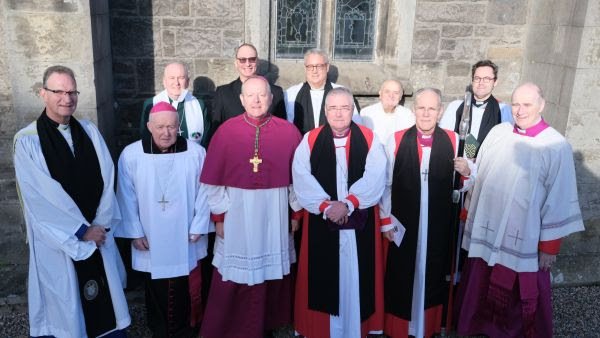
Caption Church leaders endorsing reconciliation work of the Ulster Project in Enniskillen, Co Fermanagh, Diocese of Clogher (photo credit and more information on https://clogher.anglican.org/News/newsevent.php?id=1419)
Background
On 1 November, a Service of Thanksgiving was jointly held in Saint Macartin’s Church of Ireland Cathedral, Enniskillen, Diocese of Clogher, and across the road in Saint Michael’s Catholic Church, to celebrate the fiftieth anniversary of the Ulster Project, which offers “leadership training in conflict resolution (reconciliation) with the goal of empowering Ulster Project teens to oppose discrimination of any kind.” The Ulster Project was established in 1975 and has brought Protestant and Catholic teenagers from Northern Ireland for month-long stays with host families in the United States during the Troubles. Over the fifty years, it is estimated that 25,000 young people have participated. Please see below addresses by Archbishop John McDowell, Church of Ireland Archbishop of Armagh and Primate of All Ireland, and by Archbishop Eamon Martin, Catholic Archbishop of Armagh and Primate of All Ireland, that were delivered on the day.
Archbishop John McDowell: “reconciliation is a great civic word, it is also a hard word. A very difficult thing to bring to birth or to put into effect.”
- Homily of Archbishop McDowell delivered in Saint Macartin’s Cathedral, Enniskillen.
2 Corinthians 5:17-20
If I could first of all thank the organisers of this 50th anniversary celebration and thanksgiving for the Ulster Project for the invitation to speak at this service this afternoon.
It is an honour indeed to be associated in any way with a Project which I often heard people speak about when I was Bishop of Clogher. I know that the Ulster Project has cast its net much wider throughout Northern Ireland but it always appeared to me that it was very close to the heart here in Fermanagh.
Over the past fifty years, the Ulster Project has helped transform many young lives through the cooperation of a great number of quiet people-host families, volunteers, and leaders.
Today is the Feast of All Saints and, it seems particularly fitting, that we should give thanks for the lives of all of those people who gave some part of themselves to make this reconciliation initiative a success, but who are no longer with us, but who rest in God’s nearer presence.
There is one crucial difference between the reconciliation which they and their successors (many of you here in this Cathedral today) have worked so hard to bring about, and the full meaning of the word in that passage from Saint Paul.
In the Gospel Paul was not offering good advice. He was offering good news. His message was that in Jesus Christ God’s reconciliation of the world to himself was complete and it was left to the world to receive it or reject it.
You, in the Ulster Project, have been making a slightly different offer. You have been saying to young people that the work of reconciliation in Northern Ireland is very far from complete, so come and help us and we will help you make it wider and deeper. To that extent the work which you have been involved in has been even more challenging than the work of Saint Paul.
In that passage from 2 Corinthians, Paul makes a distinction between the message of reconciliation, and the ministry of reconciliation. And that is also the case with the Ulster Project. The message is that a reconciled society in NI is the only kind of society which can nurture and fully develop the potential of all its people – in this case its young people. That is the message, and you are the people who serve that message – you are its ministers, its servants and (just like Saint Paul) its ambassadors.
Now ambassadors are usually very important people. They are given special privileges and rights because regardless of how worthy or unworthy they may be personally, they are treated as the personification of the country which they represent. But you, and I, know that is not necessarily the way everyone in NI looks on the message or the ministry of reconciliation. You also know that although reconciliation is a great civic word, it is also a hard word. A very difficult thing to bring to birth or to put into effect.
The founders and their successors in the Ulster Project wisely adopted the methods of hospitality, encounter, and ordinary friendship to achieve the goal of contributing to the building of a reconciled society. Love takes on many shapes in the world in order to achieve its ends and perhaps friendship is the most low key, the least spectacular but the longest lasting. It requires many virtues-truth telling, vulnerability, endurance and patience. Friendship is fully realistic and takes into account the way the world is and has been. Friends know that in their relationships with each other, and with the world in which they live, that there are hurts that cannot be forgotten; that lament and thanksgiving are never far apart.
You are engaged in work for the long term, in fact work that is both unending and enduring. Yet it is also work that has a thousand satisfactions and hundreds of little victories each day -harsh words left unspoken, gestures of courage and understanding quietly offered. The love and laughter of friendship. A sorrow joyfully borne.
And of course these things don’t just happen. In a society such as we have in NI, the Ulster Project deserves continued support financially and in the very practical ways by also supporting encounter programmes and committing to long term accompaniment. Encouragement too for those of us in churches to continue to partner and to invest.
But today is, above all, a day for celebration and gratitude. Celebration for all that has been achieved by way of young lives transformed and of gratitude to the many people who have made this possible. Above all, in this place, gratitude to the God and Father of our Lord Jesus Christ as we journey with him on the path of reconciliation which lies behind us and stretches out before us. ENDS.
Archbishop Eamon Martin: “The unfinished work of peace cries out for leadership on so many levels”
- Address by Archbishop Martin in Saint Michael’s Church, Enniskillen.
When we were marking the 25th anniversary of the Good Friday Agreement a few years ago, there was a definite sense of gratitude for those who had brokered the agreement, while at the same time, an acceptance that we still had a long way to go. It made me think of those words of W B Yeats, “and I shall have some peace there, for peace comes dropping slow”.
Yeats, of course, was writing about a different kind of peace and tranquility, as he dreamt about being back on the idyllic Inishfree island of his childhood, far from the grey pavements of London. Still, those poignant words speak to our “deep heart’s core” as we mark the golden anniversary of the Ulster Project. We are thankful to God for all that has been achieved, but we’re also aware of the “unfinished work” of our peace.
The Gospel passage we have just heard speaks of the coming of God’s kingdom in terms of sowing seeds – seeds that are sown in Hope, and reaped in Joy. The growth of those seeds, although sure and steady, largely happens “out of sight; out of mind”. “Night and day”, we are told, “the seed sprouts and grows – all by itself – first the stalk, then the head, then the full kernel in the head” and then, eventually, the harvest!
Today we rightly celebrate the significant harvest of the Ulster Project in helping to ‘build peace and shape the future’ over the past fifty years. Many of those who participated look back on their experience as “life changing”, but the Project was never about quick fixes or instant results. Much of the Project’s success has been gradual, often “out of sight, out of mind”, but still, it has slowly but surely helped to transform many young Christians into respectful leaders and peacemakers, who have the confidence to make a difference.
The prophetic founders and early supporters of the Ulster Project, on both sides of the Atlantic, knew that “peace comes dropping slow”, but they were determined to start somewhere. They were inspired by Faith and Hope to ask again that Gospel question: “Who is my neighbour?” They had a conviction that ultimately Good is stronger than Evil, love conquers hate, and even the smallest seed can sprout and grow into a great tree where people can gather and find shelter.
The fruits of the Ulster Project are therefore best found deep in the hearts and minds of its many past participants – now “influencers” – who have positively shaped attitudes and behaviours here, at first with their own family members and friends at school; later with their peers and colleagues, eventually teaching tolerance and respect to their own children, and now, for some, possibly even grandchildren!
But the work of peace-making remains far from over and, as Archbishop John reminded us, we all share the responsibility to be ministers – ambassadors even – of reconciliation, healing and peace. We are under no illusions; this work is not easy, especially where pain and unresolved grief lingers; when progress is stalled by mistrust or even reversed by a kind of tribal politics that thrives in closed echo-chambers of suspicion and “whataboutery”. All the greater need then, for new prophets to emerge among us who can open up spaces to nurture empathy and dialogue, knowing that no-one has a monopoly of the wounds of our troubled past.
The unfinished work of peace cries out for leadership on so many levels: including from churches, politicians, business people, educators, community and voluntary workers. We need more risk takers who can help us take courageous steps forward in the service of the common good. Where are they? I am confident that such leaders are out there, and many of them are numbered among the “graduates” of the Ulster Project; they remain our Hope for the present and the future.
The work of peace-building will of course never be exhausted. The question “who is my neighbour?” will always be asked of us, but hopefully in time we will be able to see beyond the usual in-fighting and the old distinctions, labels and prejudices to realise that our love and responsibility cannot be reserved only for ‘our own kind’. There are so many other marginalised people out there lying largely unnoticed ‘at the side of the road’. They are our neighbours of all persuasions who are trapped in poverty; they are the vulnerable, sick and lonely – the shunned migrant, the tormented addict, the family torn apart by the scourge of domestic violence, the despairing young adult contemplating the taking of her or his own life.
When we have the eyes to see this, and the determination as a society to do something significant about it, then we will know that our peace, which has been dropping slow, is at last maturing.
The year 2025 is a ‘Jubilee Year’ in the universal Catholic Church – that is a special year of prayer and reflection that is called every quarter of a century. The theme of this Jubilee Year is “Pilgrims of Hope”, that Christian hope which Saint Paul described to the Romans as “the Hope that does not disappoint”.
Of course 1975, the year in which the Ulster Project was founded, was also a jubilee year, and coincidentally the theme chosen back then was “Renewed in Hope”.
So, the Ulster Project was born in Hope, and continues in Hope! My hope-filled prayer then is that this anniversary will re-energise among us a spirit of solidarity and generosity so that with God’s help, we can renew our determination to shatter the prejudices and stereotypes that keep us isolated and separate; to quicken the pace of peace; and to, create a society where it is normal to be pilgrim of Hope, build bridges, cross the road and recognise that the stranger over there is really our friend.
ENDS